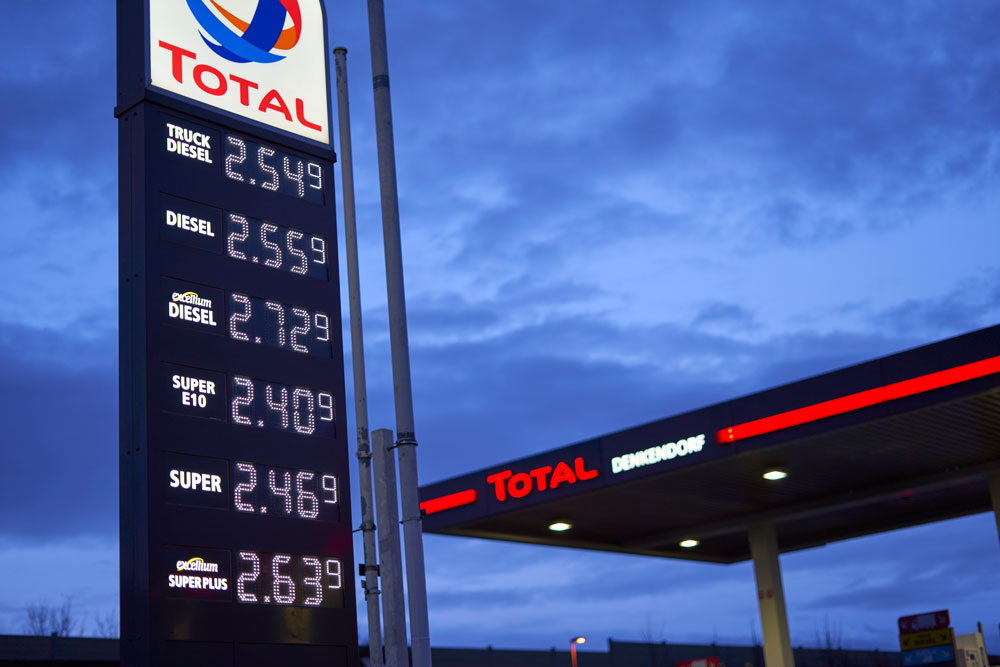
 Diesel and petrol prices are once again under pressure. Just as markets seemed to stabilise, new international tensions are creating fresh uncertainty – and pushing up costs across the transport sector.
Only a few weeks ago, political tensions surrounding Venezuela sparked renewed debate about possible restrictions on oil production. Before that, the war in Ukraine had already had a major impact on energy prices across Europe. Now, an escalation of tensions in the Middle East involving Iran is once again causing turbulence on global energy markets.
The effects are felt almost immediately:
-
 Oil prices react quickly to geopolitical risks , particularly when potential supply disruptions in the Middle East are discussed. Market analyses show that even political tensions or disruptions affecting key shipping routes can have an immediate impact on global energy markets. Recent developments in the region, for example, have already pushed oil prices higher as traders reacted to escalating conflict and the risk of disrupted supply from the Gulf, as reported in analysis of the Middle East crisis and rising oil prices.
-
Fuel prices at petrol stations across Europe often rise quickly when international market prices increase. For example, reports highlighted a sharp surge in diesel prices across Europe as tensions in the Middle East and fears of supply disruptions pushed energy markets higher.
-
Short-term price jumps also regularly trigger criticism. After sharp increases, observers often point out that rising oil prices are passed on to motorists very quickly – even though a significant share of the fuel being sold was purchased earlier at lower prices. In the current debate, for example, fuel retailers have been accused of rapidly increasing pump prices following rising wholesale costs linked to tensions in the Middle East, sparking renewed discussion about how quickly price increases are reflected at petrol stations.

-
Governments therefore repeatedly consider possible interventions. In Germany, for example, the Federal Cartel Office has examined developments in the fuel market and launched investigations into competition and pricing structures, particularly during periods of strong price increases. The aim is to ensure that crisis situations are not used to impose excessive prices on consumers and that fuel markets remain competitive and transparent, as outlined in a recent statement by the German Federal Cartel Office on refinery and fuel market developments.
The reason is clear: a large share of global oil trade passes through the Strait of Hormuz, through which roughly 20 % of the world’s oil supply is transported. Disruptions or political tensions in this region therefore have an immediate impact on international energy markets – which is why the strategic importance of the Strait of Hormuz for global oil trade repeatedly moves into focus.
The current situation once again highlights a familiar pattern: global crises lead to significant price volatility – and companies in the transport and logistics sector bear a substantial share of the resulting economic risk.
Fuel costs remain one of the largest cost factors
For many companies operating vehicle fleets, fuel costs represent one of the largest variable cost components. Even moderate price changes can have a significant impact.
Example:
A fleet of 20 vehicles with an average annual mileage of 40 000 km per vehicle amounts to roughly 800 000 kilometres driven per year. With an average consumption of 8 litres of diesel per 100 km, this results in an annual fuel requirement of around 64 000 litres.
 If the diesel price is €1.80 per litre, fuel alone already accounts for around €115 000 in annual costs.
If the price rises by 30 cents per litre – a magnitude that can easily occur within a short period during geopolitical crises – the annual fuel bill in this example increases by around €19 000. For larger fleets or higher annual mileage, such price movements can quickly add up to additional costs in the five- or even six-figure range.
However, even if external price shocks were to subside in the future, the long-term trend still points clearly in one direction. With increasing CO₂ charges on fossil fuels and the planned European emissions trading system for transport and buildings (ETS 2), petrol and diesel will gradually be priced more heavily. The aim of these instruments is to systematically increase the cost of fossil fuels through a rising CO₂ price, as explained in policy analyses on the EU’s carbon pricing framework.
Transparency in fleet operations: The key to efficient fuel use
Efficiency instead of dependence: Fuel-saving potential in vehicle fleets
Studies and practical experience show that in vehicle fleets, fuel savings of around 10–15 % are often achievable. This potential does not arise from individual measures, but from the systematic analysis and optimisation of vehicle usage and driving behaviour.
 The most important prerequisite is transparency: only what can be measured can be optimised.
Companies must first capture their actual fuel consumption in detail – broken down by vehicle, by route and ideally also by driver. Only then can they identify differences, analyse underlying causes and implement targeted improvements.
Transparency enables better decisions
Analysing this kind of data allows companies to, among other things:
- identify vehicles with unusual consumption patterns, for example due to technical issues, less efficient vehicle models or underperforming engines
- compare fuel consumption between drivers in order to recognise particularly efficient driving styles
- organise targeted driver training where clear differences in driving behaviour become visible
- reduce idling times and unnecessary detours
- optimise routes and operational planning
Many of these measures can now be analysed and evaluated largely automatically, provided the relevant vehicle and driving data are available.
Transparency benefits drivers too
 The analysis of such data is not only relevant for the company. Drivers also benefit when they receive direct feedback on their driving behaviour and fuel consumption.
When drivers can clearly see and understand their own fuel use and driving style, they can actively improve their performance in day-to-day operations. Many companies therefore provide their drivers with reports or feedback systems that make this information transparent.
Surveillance or normal business practice?
From time to time, questions are raised about surveillance or data protection in this context. In reality, however, the issue is something far more fundamental: normal operational management and performance evaluation.
Companies need to analyse their work processes in order to keep efficiency, costs and competitiveness under control. In many areas this is entirely standard practice – for example when looking at production metrics, sales figures or project timelines. In fleet operations, fuel consumption per vehicle, route or driver is simply another operational performance indicator.
Precisely because fuel costs represent a significant share of operating expenses, analysing and evaluating this data is not only legitimate for companies – it is an economic necessity.
 Another important aspect is this: a financially successful company is also in the interest of its employees. Only when costs remain under control and businesses stay competitive can jobs be secured in the long term and incomes remain stable.
The analysis of vehicle and fuel consumption data is therefore not a question of surveillance, but part of modern and responsible business management.
Efficiency is a shared interest
Many companies therefore go one step further and combine efficiency measures with driver incentive systems. In practice, fuel savings are often partially shared with drivers through bonus schemes.
The company reduces its operating costs and becomes less vulnerable to rising energy prices. At the same time, drivers benefit from additional compensation for efficient and forward-looking driving.
This creates a classic win-win situation: greater efficiency for the company – and a financial incentive for drivers.
Digital fleet analysis with TSI Fleetmanager
With TSI’s telematics solutions, fuel consumption, driving behaviour and operational data can be systematically captured and analysed. The platform provides detailed analytics, including the evaluation of individual trips, vehicles and drivers.
Among other things, the system enables:
- Detailed analysis of fuel consumption data and driving profiles
- Evaluation of efficiency and fuel use per trip and per driver
- Detection of inefficient driving patterns or excessive idling times
- Comparison of vehicles and drivers based on objective data
- Aiding route and operational planning
This transparency provides companies with a clear and reliable data foundation to identify efficiency potential and implement targeted improvements. At the same time, defined targets and efficiency indicators can be tracked transparently – an important prerequisite for driver feedback, training measures or performance-based incentive schemes.
TSI Fleetmanager also offers a wide range of additional features for operational fleet management. These include remote tachograph downloads, tools for live dispatching and operational planning, as well as extensive functions for analysis and reporting.
Companies therefore gain not just a tool for analysing fuel consumption, but a comprehensive platform for modern fleet management.
Depending on the specific operating profile, fuel savings of around 10–15 % are realistic. This estimate is not based solely on theoretical analysis, but is regularly confirmed by many of our customers in practical use.
As a provider of telematics solutions with many years of experience, TSI Telematic Services GmbH supports companies with a broad portfolio of applications for a wide range of operational scenarios. Particularly in passenger transport and bus operations, where fuel costs and efficient operational planning play a crucial role, TSI offers specialised telematics solutions for bus operators.
Efficiency as a strategic advantage
 Geopolitical crises, volatile energy markets and rising CO₂ costs make one thing clear: companies have very little influence over the development of fuel prices. This makes it all the more important to actively manage fuel consumption and operational efficiency.
Transparent data on vehicles, trips and driving behaviour provides the necessary foundation. Companies that systematically analyse and optimise their fleets not only reduce their ongoing operating costs – they also become less vulnerable to external price shocks.
Digital fleet solutions such as TSI Fleetmanager help companies make these efficiency potentials visible and turn them into practical improvements in everyday operations.


 Deutsch